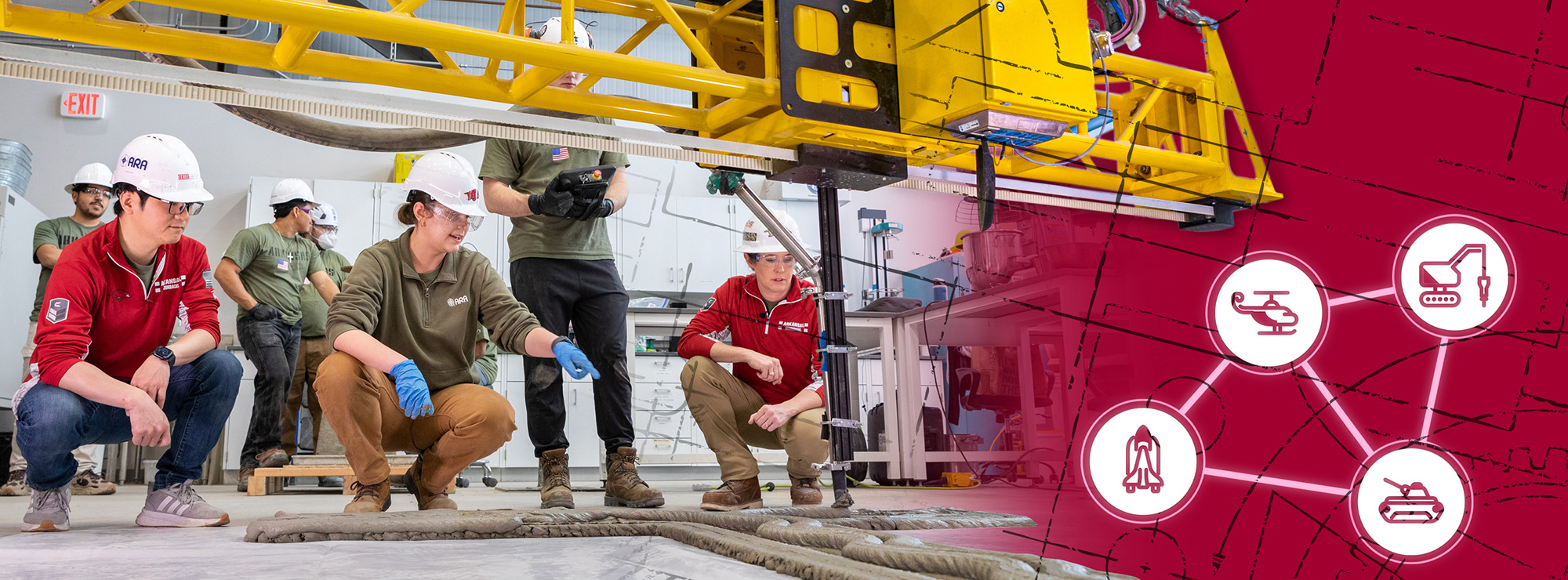
The Revolution Will be 3D Printed
How the U of A is designing 3D printed concrete infrastructure for the U.S. Army
To hear Wenchao Zhou tell it, the 3D printing revolution is coming. Supply chain networks, which ship raw materials from the Americas thousands of miles to Asia and back again as new products, will wither away, dinosaurs of inefficiency and waste. Factories will become general purpose, localized to reduce transportation costs and able to manufacture whatever is desired with basic materials as feedstock. And out will come golf clubs, prosthetic limbs or chocolate treats.
“It’s very expensive to build a factory for a specific product,” Zhou explains, “and when a product goes away, like a floppy disk or CD, the factory faces the end of its life. With a general-purpose factory, you can fundamentally decouple the factory life from the product life. You can replace old robots with new robots; you can update the software, but the factory will never disappear.”
That radical reshaping of manufacturing may still be some ways off, but Zhou, an associate professor of mechanical engineering at the University of Arkansas, is doing his part today to optimize long and inefficient supply chains through 3D printing (putting it in line with university’s recently announced priority research growth areas). He’s partnered with Michelle Barry, an associate professor of civil engineering at the U of A, who is the principal investigator on an innovative new project called ACME (for Additive Construction Maneuver Enhancing) Tech, which is sponsored by the U.S. Army Engineer Research and Development Center (or ERDC).
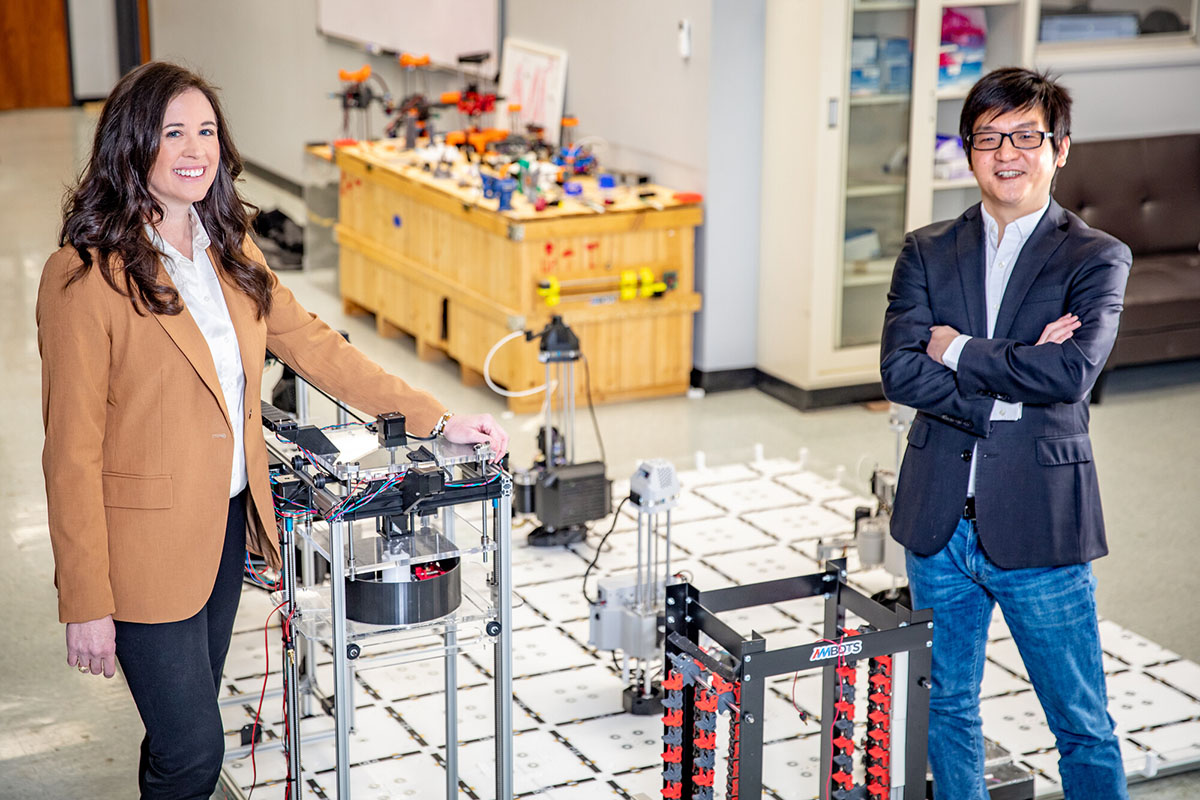
As Barry explains their project, “ERDC has charged us with developing the tools and methods necessary to enable the army to show up at a site, harvest the local indigenous soils and 3D print concrete infrastructure items needed to move people and goods from point A to point B.”
SHRINKING THE SUPPLY CHAIN
Barry, who oversees the Granular Materials Research Laboratory, leads the materials teams while Zhou leads the software development team, both working in partnership with Applied Research Associates (ARA) and Iowa State University. To date, several million in research funding has flowed to the U of A to develop “horizontal infrastructure” (think culverts, T-walls and Jersey barriers) through additive construction, otherwise known as a 3D printing.
The idea is that an expeditionary force will be able to deploy and make use of local materials in construction rather than ship precast pieces across enormous distances, which is the current practice. The force will instead have a convenient catalog of recipes for concrete mixes adapted to local conditions with the assurance those mixes can be pumped through nozzles and 3D printed. So 3D printers will be shipped instead of precast pieces. While they will still have to transport cement, shipping half of a mountain is still much better than transporting a whole one.
“Using local soils greatly reduces the logistical burden associated with horizontal infrastructure,” Barry explains, “especially construction in remote environments, and when coupled with additive construction it allows us the flexibility to print any item of need at the point of need. For example, we can print culverts and change to retaining walls if needed or print different sizes of items, all with a simple file change sent to the printer.”
THE RIGHT MIX
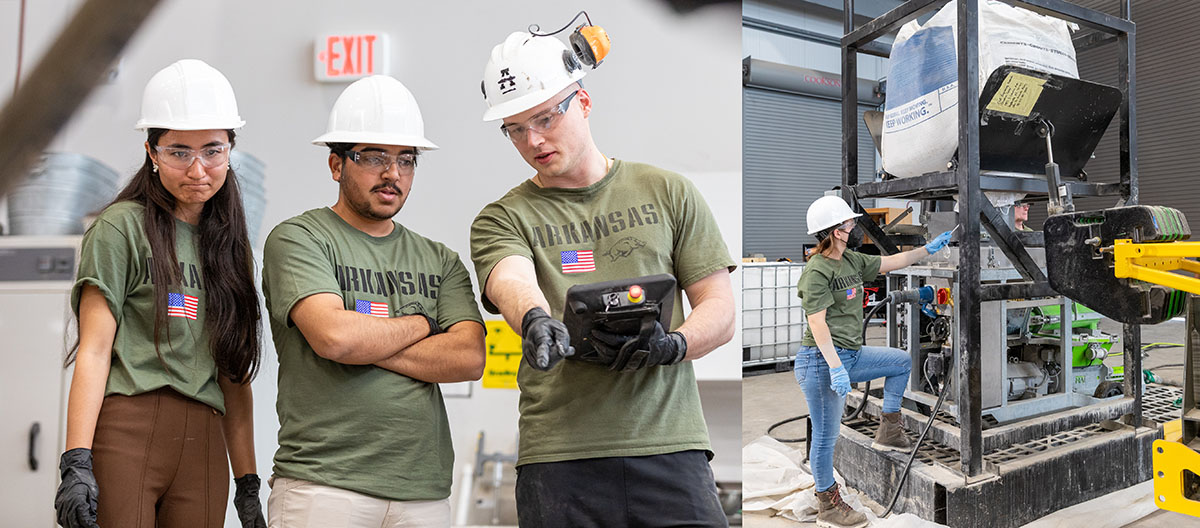
Barry’s team is focused on characterizing the indigenous soils, developing mix designs, and then testing the strength of the concrete and the performance of the overall structure. She notes that 3D concrete printing requires concrete to have a specific consistency.The mix must be flowable enough to be pumped and extruded as a continuous bead, but it also must be stiff enough to be buildable and hold its shape as new layers are added. Using indigenous soils adds another layer of complexity to the design because different soils result in different consistencies and require different additives. They also perform differently in terms of shrinkage and strength.
To date, Barry’s team has characterized more than 16 soils from around the world and 23 soils from across the United States. From that, they’ve created hundreds of mixes, gradually winnowing out the good from the bad until they have a viable formula. Instrumental in this work is Bailey Downing, a former master’s student of Barry’s who’s now a staff engineer with ARA and spends much of her time onsite in Fayetteville.
“When creating a mix design, the first thing you need to know is the indigenous properties,” Downing says. “So, understanding the gradation or the sizes of the material, understanding how it behaves. Is it plastic or non-plastic? We like plastic material because it acts like a clay. And that makes our material go from a liquid like a water to more of a honey consistency.
“One thing I've been trying to specialize in is limiting the amount of cement that’s needed for our mix designs,” she continues. “So basically I am cooking. I create different proportions of cement, indigenous materials, admixtures, put it in a mixer and then test the pumpability.”
Zhou adds that “one of the biggest differences between working with concrete versus working with plastic is that concrete has a lot more mass and inertia. So once you’ve started, you can’t be easily stopped. That means when you extrude concrete, you need to make sure you have as few stops as possible — and preferably one single continuous tool path. So that's a very hard mathematical problem.”
THROWING OUT THE CODE BOOK
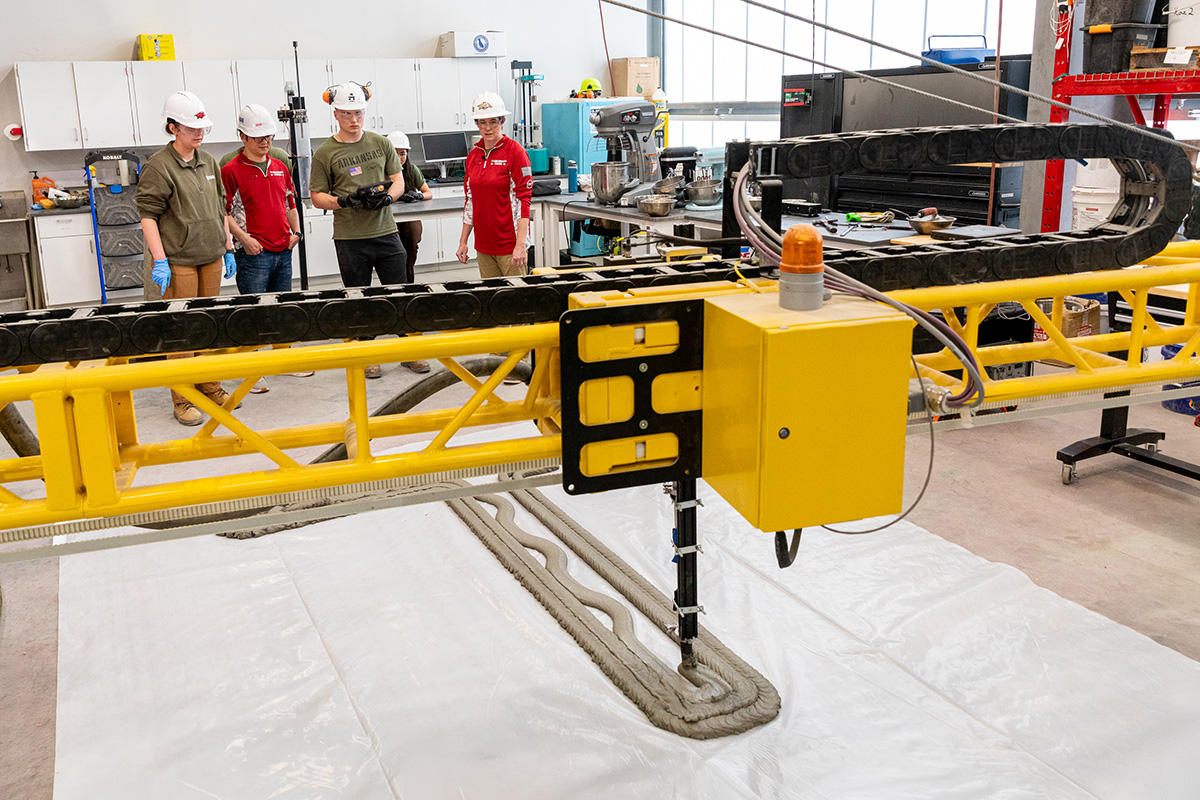
The director of the Advanced Manufacturing, Modeling and Materials Lab at the U of A, Zhou is also a co-founder of AMBOTS, a local company developing swarm manufacturing technology. AMBOTS is responsible for building software that can translate 3D designs into machine instructions executed by the printer (created by Robotic Construction Technologies, the printer resembles a miniature crane with a fifteen-foot radius). Zhou doesn’t just specialize in 3D printing but in using multiple autonomous robots, or swarm manufacturing, to work cooperatively on large print jobs. For now, the team has been using one industrial printer, but moving to swarm manufacturing would be a logical evolution of this construction technology — especially for objects with a very large footprint, like a factory or a military operation where speed may be a necessity.
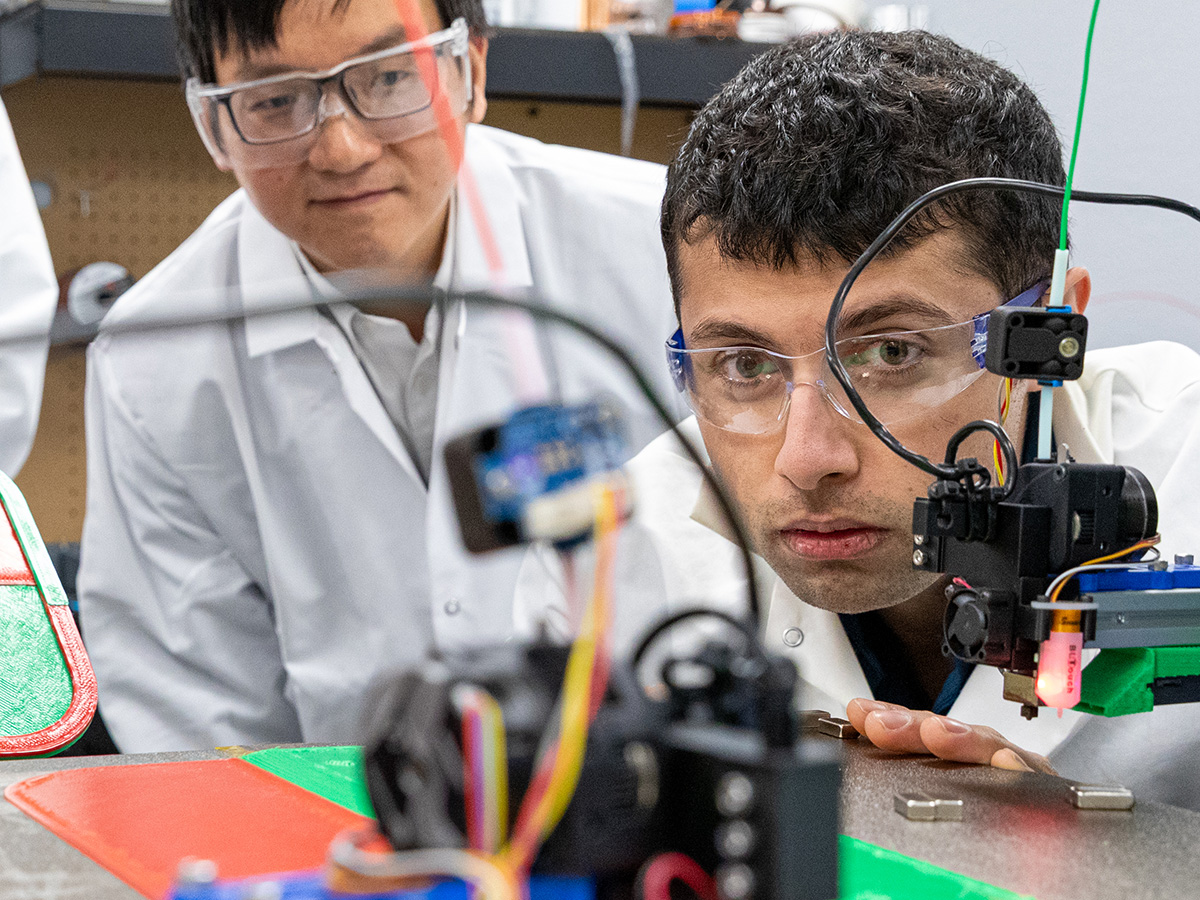
Zhou notes that the need to print in a continuous toolpath has resulted in the need for new printing patterns. They started with a zigzag pattern and moved to a more rounded, sinusoidal wave shape. Printing with concrete also eliminates the need for formwork — the wood, metal or plastic used to mold fresh concrete. Formwork can add substantially to the cost of construction and, depending on the material, can only be reused a few times. It also typically restricts objects to simple shapes rather than a more optimized pattern. All of these differences takes the work far from well-established construction codes and practices.
James Stewart, a Ph.D. student working on the project, noted what a unique opportunity the project is. “Whenever you're conducting normal structural design,” he explains, “you're designing out of a code book with a set of requirements. We all take classes in undergrad that teach us how to do that, how to apply that code correctly. But for objects that we might print here in the lab, the geometry is varied and sometimes we vary them, to make them optimal in terms of structural performance or some other factor.”
PROOF OF CONCEPT
Printing experimental objects in the lab is one thing, doing it in the field another. Last fall, several members of the research team, including everyone named here and several more graduate students, went to Fort McCoy, Wisconsin, to demonstrate the feasibility of the technology. The intention was to show up without prior knowledge of local soils, characterize them, and run through a series of field tests to determine whether the best option was conducive to being pumped and extruded. As a part of the demonstration, they taught the process to soldiers without engineering or technical backgrounds.
“By the end of the week,” Downing says, “they were using the equipment by themselves.”
Ultimately, they printed eight round culverts and then assembled them in a long culvert system, confirming the validity of ACME Tech.
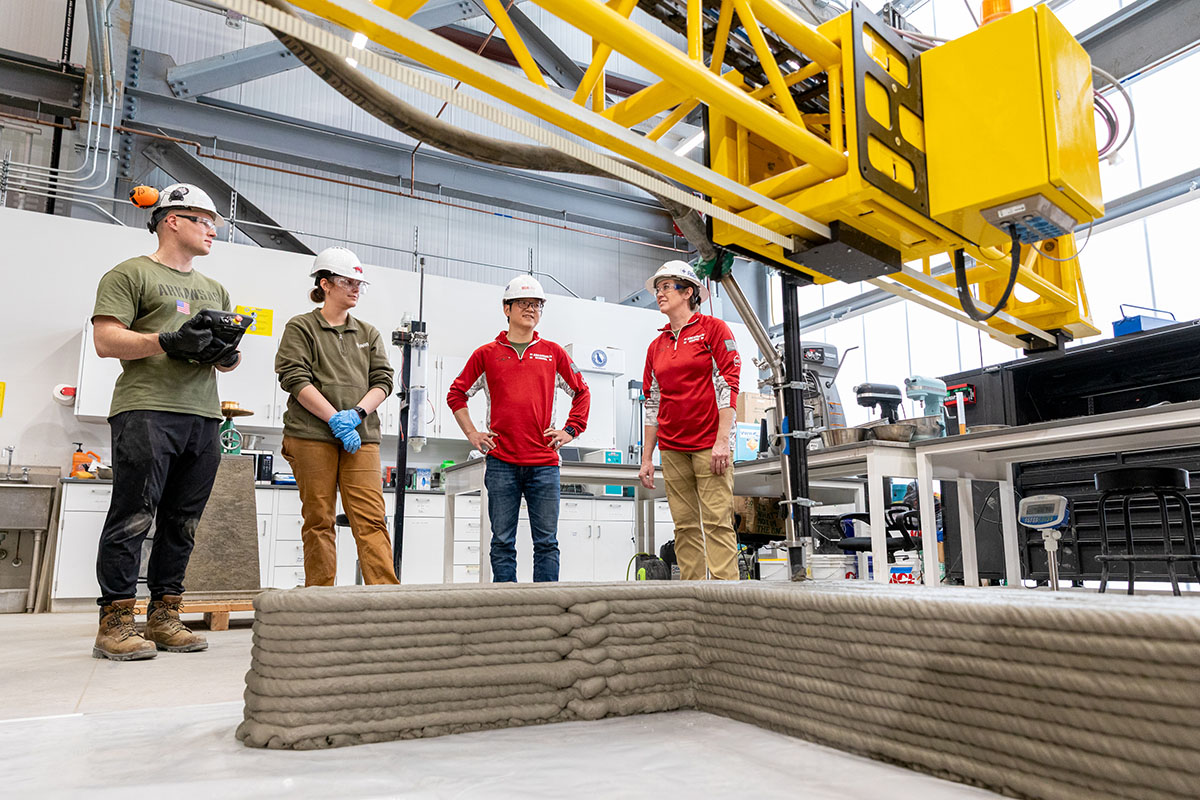
All in all, the project presents an exciting opportunity to advance additive construction and establish the U of A as a leader in the field. Barry says, “This funding has allowed us to develop a state-of-the-art research facility in additive construction and it has supported a large number of engineering students who are trained in this area.” Those students will be entering the workforce and helping translate the technology to civil infrastructure.
Some of the researchers are already looking beyond the immediate military benefits of the technology, and even beyond the obvious civilian uses, such as rebuilding infrastructure after a natural disaster or creating affordable housing, warehouses and bridges. Stewart suggests this technology may be useful in places where humans may not want to work, like space.
Barry agrees: “If we even wanted to think about going to the moon or Mars, you know, we don’t want to transport materials there because it is cost prohibitive. We actually want to use local materials with equipment capable of printing items under those unique conditions.”
As plastic, metal, foods and concrete pour from the nozzle, and even more objects are broken down by slicer software, Zhou’s anticipated revolution in 3D printing is inching ever closer. Increasingly, it seems the revolution might mirror Ernest Hemingway’s famous description of going bankrupt: It happens in two parts: “Gradually, and then suddenly.”